
Progetti
A New Sports Model is Gaining Ground in Europe
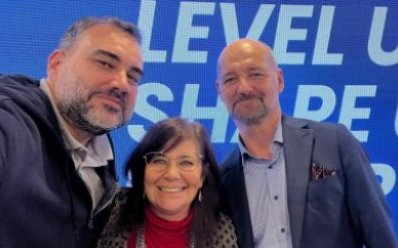
What is the future of sports in Europe? Why is the pyramid model of sports no longer sustainable, and why is a new approach needed? Why should European policymakers listen to the demands of social organizations promoting sport for all? To try to find answers to these questions, we spoke with Mogens Kirkeby, president of ISCA-International Sport and Culture Association, and Tiziano Pesce, national president of UISP, both of whom were present at the international meeting of the international project “Real European Sport Model”, currently taking place in Bologna with European partners in attendance. From the joint interview, a complex picture emerges, rich in insights and originality, and a common European vision of social sport for all is beginning to take shape.
Is there a European sports model emerging from the “Real European Sport Model” project and the international meeting in Bologna?
Mogens Kirkeby, ISCA: “The project’s goal is to develop and increase participation in sports and recreational activities. We believe that in the various European countries, all stakeholders—from policymakers to others—must make the best decisions based on real-world data; therefore, we must find the best way to describe the models that reflect the reality we have in the different countries.”
Tiziano Pesce, Uisp: “The current situation in Italy, amid legislative reforms of the sports system and the third sector, represents a unique case at the European level. Uisp is a key player in this process and is fully committed to the initiatives of The Real European Sport Model project, which is prompting us to look very closely at the present with a commitment to share with national and supranational policymakers the complete move away from the pyramid-shaped sports model.”
Why has the pyramid model of sport failed?
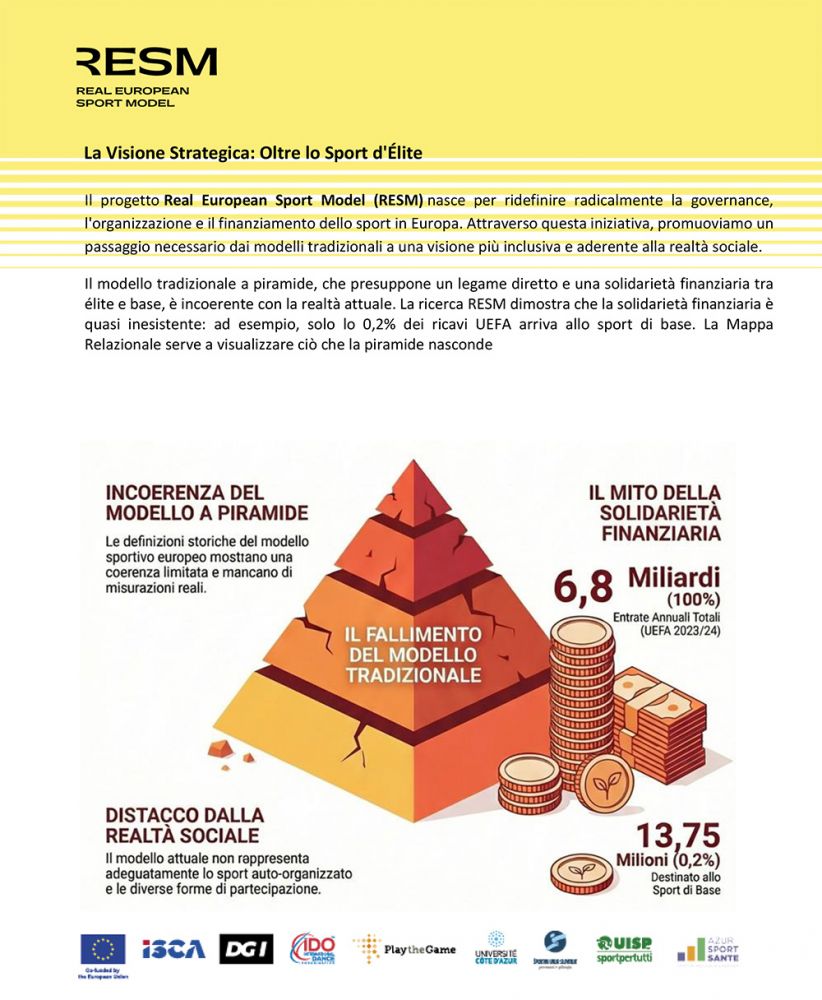
Mogens Kirkeby, ISCA: “Yes, the work we are doing seeks to describe the differences in the model, across all European nations, especially the gap between the reality described by the European model and what should emerge from the work we are doing. Why has the pyramid model failed?
The reality of sports in any community and in any European country is very complex. There are groups of people going through different stages of their lives and of different ages, from children to the elderly. Therefore, a complex reality cannot be illustrated in a pyramidal structure, which is too simplified and takes into account only a very small number of people who practice sports in different countries.”
Tiziano Pesce, Uisp: “Scientific evidence shows that the so-called pyramid model has failed because it does not account for the major shift of recent years: the emergence of new participants in the sports landscape, new practitioners, and new profiles. The Real European Sport Model project and the comparison of what is happening in various European countries show us that today we are facing new complexities and responsibilities of representation. On the other hand, the aim of the project was precisely to envision the characteristics of the emerging model—one that is truly European and social.
The pyramid model, based on the narrative that the elite at the top supports the base through supposed financial solidarity, is a false myth—one that has collapsed and is now completely inconsistent. That framework, which underpins the structure of many National Olympic Committees, does not reflect the complexity of modern sports participation, completely ignoring the diverse forms of active citizenship and grassroots sports, whether organized or widespread. A model that represents a profound disconnect from the social reality that, as associative networks, we experience every day in our local communities, with participants, managers, staff, and volunteers.”
Until recently, European social sport for all promoted the so-called “cathedral model,” which highlighted the importance of a very broad base of participants. Has that type of model managed to attract the attention of European governance bodies? Has it managed to make itself heard?
Mogens Kirkeby, ISCA: “The cathedral model developed about ten years ago and certainly better describes the complexity of participation in sport across different countries. But despite this, although it seems the most accurate, it has not effectively gained traction in dialogue with institutions. I would say that some of the most authoritative voices, such as those in soccer and UEFA, remain anchored to the classic pyramid structure. One could say they have good reasons to think this way, because it describes what they do. We, on the other hand, argue that it does not describe the reality of sport and the way people participate in it.
I would say that rather than talking about models and descriptions, it is more accurate to talk about approach. What we believe is fairer and more important is to view reality not from an organizational perspective but through the eyes of citizens—children, adults, and the elderly. To describe their needs, their questions, and their requirements. Adopting this approach is far more beneficial for sport itself.
Last year, a meeting was held at the initiative of the European Commission, which asked us for feedback on the European sports model. The report has been published; it was summarized in nine pages, and only 40% (OR 14%) of the responses collected from people in various countries believe that the European sports model is adequate and reflects the reality in Europe. There are also other significant indicators emerging from the report that prompt reflection on a range of other issues."
Tiziano Pesce, Uisp: "We therefore believe that a paradigm shift is needed, and the evidence emerging from the RESM project is beginning to demonstrate this very clearly. I think we must move beyond the ‘pyramid’ that continues to place federations and competitive results at the centre, through a new relational approach that centres on sports activities for everyone, experienced daily by citizens, even in increasingly fluid forms. In this sort of map, organizations like Uisp are not marginal entities at the base of someone else’s structure. We are an organization of active citizenship, expressing associationism and active sports participation, operating at the key intersections between the public sector, the private sector, and civil life.”
After 10 years, you have defined a new model. What is this model called, and what are its main characteristics?
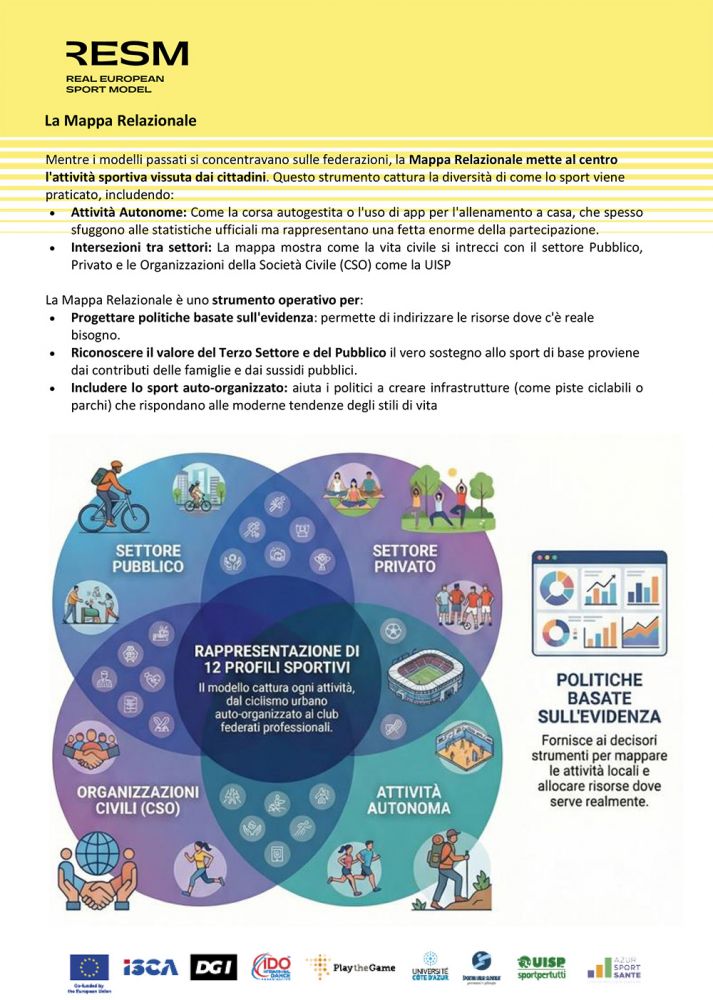
Mogens Kirkeby, ISCA: “We sought to study the reality, and from what emerged, we defined a sort of European Relational Map of Sport. It is not strictly a model, but rather an indication that there are many different ways to practice sport. There are various models and different types of organizations that interact within each sports system. The model highlights different ways of practicing sports, even if the same type of activity is offered by organizations that differ from one another. I’m not sure if it’s a model; I’d define it as an approach that illustrates the variety and diversity within this complex sector.”
Tiziano Pesce, Uisp: Uisp has long been committed to guiding and supporting this transition. In short, we are calling for a sports model—we could summarize it this way—that is real, because it meets people’s needs; European, because it is based on the values of health and inclusion; and social, because it is capable of generating the common good, which absolutely requires concrete actions and resources.”
Starting from this approach, what chance does the European “sport for all” movement have of having its demands heard by European governance? And what are these demands?
Mogens Kirkeby, ISCA: “The main task is to guide public decision-makers toward understanding the reality. One can operate with blinders on and hear nothing, and that would likely not be positive. What we are calling for is a balance between political assessments and financial support. At the moment, this relationship is very unbalanced because it focuses heavily on winning a medal, which is a positive thing. The problem is that this aspect of the phenomenon is minimally representative of the entire sports movement, in which the vast majority of people have entirely different motivations and goals. This means shifting the focus of policymakers from elite sports to grassroots sports, to achieve a balance that better reflects reality. A balance that entails greater attention both politically and in terms of public funding.
In recent years, there has been increased political pressure from citizens on institutions. There is a possibility that civil society can flourish again, gain more political space through sport, which has established itself as a sector capable of providing widespread and economically accessible services to the entire local community. This growth in citizens’ social agency through sport is a very positive sign for the future, as it signals the rebirth of the public political sphere".
Tiziano Pesce, Uisp: "The European ‘Sport for All’ movement, led by ISCA, has had the merit in recent years of bringing to the attention of European policymakers the issue of a broad movement of participants that, on the margins of sports and political institutions, was growing and consolidating. A critical and self-aware movement, seeking its own place within the sports system, with full citizenship and equal dignity. In Italy, Uisp has picked up on these social trends, alongside other associations genuinely interested in the development of social sports for all, capable of expressing individuality and representation.
Today we are able to assess this journey and realize that it is the same vision that is taking shape in other European countries. In short, we need to look, now more than ever, to the founding values of the European Union, enshrined in Article 2 of the Treaty on the EU: respect for human dignity, freedom, democracy, equality, the rule of law, and respect for human rights, including those of minorities. Values shared by Member States in a society characterized by pluralism, non-discrimination, tolerance, justice, solidarity, and equality. And in all of this, grassroots sports and social sports can truly make a significant difference.”
In this approach that you call relational, the aspect of interaction and democratization is fundamental. It is a model, a very significant approach. Can the same be said of the Olympic system? Is the Olympic system equally so today?
Mogens Kirkeby, ISCA: “To speak of democracy in relation to the IOC’s international Olympic system means giving the term ‘democracy’ a very broad meaning. The IOC is not organized to be democratic, and it would be inappropriate to define it as such: it does not have a democratic composition, and the decisions it makes are not communicated transparently. The funds it manages are distributed in a way that is unfavourable to grassroots sports and to the vast majority of participants. It is a system that does not take care of grassroots sports, and therefore not of all citizens who participate in sports.
The IOC and UEFA are very representative of the problems we are discussing. The Olympic Committee includes about thirty disciplines that are featured in the Games, but we know full well that around a hundred sports are practiced in European countries. UEFA is the classic pyramid structure represented by international tournaments. So, we have two major organizations, two major voices, yet they represent only a third of the sports disciplines and therefore of the participants.”
Tiziano Pesce, UISP: “We believe that the IOC, too, can find the strength within itself to renew and democratize. Sport is a major social and political phenomenon of our time; it lies at the heart of economic and diplomatic interests, shapes public consciousness, and holds a significant place in the collective imagination and the media. It cannot continue to turn a blind eye to the responsibilities it bears—whether in terms of health promotion, education, ethics, human rights, or social values. It is time for politics, at all levels, to fully recognize this value and focus on people, allocating resources where investments are truly needed for the well-being of citizens, from the youngest to the oldest. We do not need only stadiums, but above all light infrastructure, bike paths, parks, and urban spaces that respond to modern lifestyle trends; a demand for sports is emerging that represents the true critical mass of participation.
UISP has long been committed to guiding and supporting this transition, which we call the sports transition. In short, we are therefore calling for a sports model—we could summarize it this way—that is real, because it meets people’s needs; European, because it is founded on the values of health and inclusion; and social, because it is capable of generating the common good, which absolutely requires concrete actions and resources.”
In a month’s time, we will have Move Week, the most important European event for sport for all, promoted by ISCA in Europe and by UISP in Italy. In such a difficult period, troubled by international conflicts and wars, is there a message that sport can send to the world through Move Week, which will take place from May 25 to 31?
Mogens Kirkeby, ISCA: “We are certainly facing major conflicts; we stand in solidarity with those who are suffering, and we are aware that there are a very high human and economic cost. This awareness of ours can also be expressed through events like Move Week, which foster democratic participation and resilience. For civil society, sport is a space where democratic practice is effectively lived out every day, by organizing and providing services and activities to local citizens."
Tiziano Pesce, Uisp: “Sport today is capable of promoting systemic change; it fosters relationships and friendship among peoples because it makes everyone aware of the shared values it embodies health, the environment, solidarity, and rights. It allows us to recognize others by first recognizing ourselves, through the dignity and respect that every human being deserves. Sport creates identity because it recognizes the identity of others. From this perspective, I believe that international initiatives like Move Week foster relationships and intercultural exchange, as well as the values of peace and cooperation. For this reason, UISP is proud to be the lead organization in Italy for this European event, and this year as well, through the contribution of dozens of regional and local committees and with the collaboration of thousands of sports associations and clubs across the country, we will do our part.” (Interview by Ivano Maiorella. Contributor: Daniela Conti, National Coordinator for Intercultural Policies and Cooperation)
Project funded by the European Union. The opinions and views expressed are, however, solely those of the author(s) and do not necessarily reflect those of the European Union or the Education, Audiovisual and Culture Executive Agency (EACEA). Neither the European Union nor the EACEA can be held responsible for them.
NOTIZIE DA UISP NAZIONALE
CONTATTI
Ufficio progetti - Sede Uisp Nazionale
L.go Nino Franchellucci, 73 00155 Roma
Tel.: +39.06.43984350 - 345 - 346
Fax: 06.43984320
e-mail: progetti@uisp.it
Facebook
Twitter