
Progetti
European Sport for All and a Comparison of Various Systems

Why are a growing number of Europeans more interested in watching sports than in playing them? And what can be done to reverse this trend? A comprehensive new report has challenged some long-standing assumptions about the European Sports Model (ESM) and proposes a radical rethinking of the current structure.
This is being discussed in Bologna, where, through April 17, the partners of the Real European Sport Model project—of which Uisp is a partner—are gathered: the meetings are taking place at the Uisp Emilia Romagna headquarters, at Via Riva Reno, 75/3. On the morning of Thursday, April 16, advocacy training workshops are scheduled for the project partners; at 12:00 PM, Mogens Kirkeby, ISCA President, will speak, offering a brief introduction to the discussion on the European Sports Model and the Real European Sports Model project. Following this, there will be a focus on the sports model in the Italian context. Additionally, workshops and in-depth sessions on advocacy and European sports policies are on the agenda.
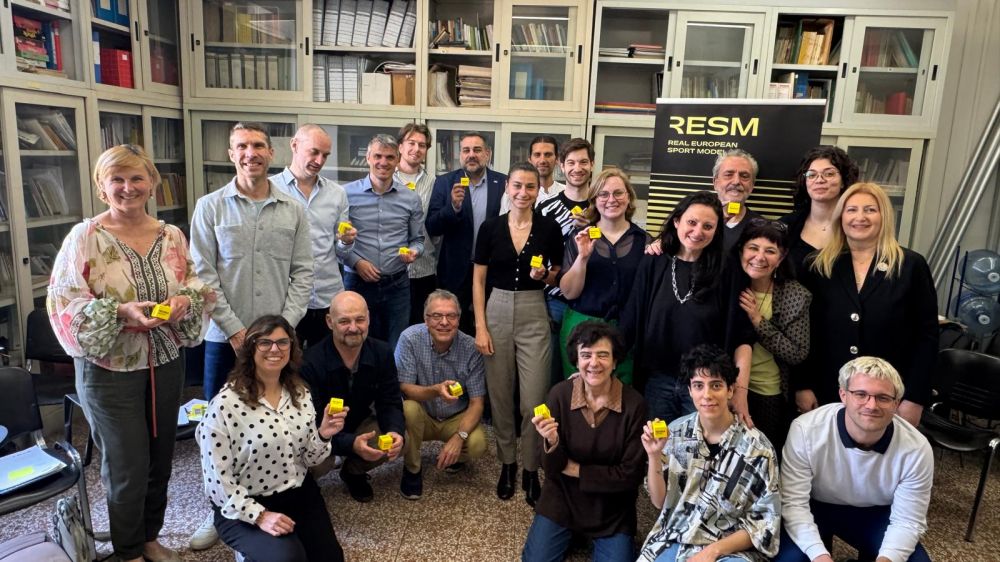
“The RESM project works to identify, promote, and above all propose to the European Commission a new sports model that includes the widest possible population in the recognition of sports participation,” explains Vincenzo Manco, coordinator of the project’s Scientific Committee and head of the UISP Study and Research Center, "not just the elite level of participants, as represented in the current European pyramid model, but also the grassroots level of participants. Above all, we want to propose a European model that recognizes the levels and sources of funding for all forms of sporting activity, which today, however, are largely unrecognized. Even today, in fact, the collective imagination still views the relationship—and thus the resulting model of the European sports system—as strictly pyramidal, with the top tier intervening to fund and support grassroots sports, whereas this is not what happens in reality."
Over these three days, we will focus on advocacy actions that can be implemented in the relationship between organizations, civil society, and local public authorities, while also considering regional and national levels up to the European dimension. This is, in particular, the scope of work assigned to UISP in the project.
“Thursday, April 16, will feature the presence and contributions of representatives from the City of Bologna, as well as other municipalities and provinces,” Manco continues, "with whom we will explore the most effective strategies to challenge the stereotype that in the sports system, it is the top that funds the pyramid, thereby seeking to reverse the common perception that still circulates in the public debate on sports at the European level. Above all, we will ask ourselves how to contribute to building a sports culture that is increasingly inclusive and increasingly recognized as a social value, a source of physical and mental well-being, and for its educational function, as the Italian Constitution itself now acknowledges."
Internal working groups are planned among representatives of the countries involved in the project, including UISP, as well as discussions with institutional representatives, to explore the most effective ways to ensure that the new European sports model we aim to promote through this project can increasingly become a shared model. “In particular, from the perspective of resources and the recognition of various forms of sporting activity,” concludes Vincenzo Manco, “we would like to define a new concept of a European sports model that embodies everything UISP has always stood for in its vision of social sport for all: the promotion of rights, active citizenship, and the fight against inequality.”
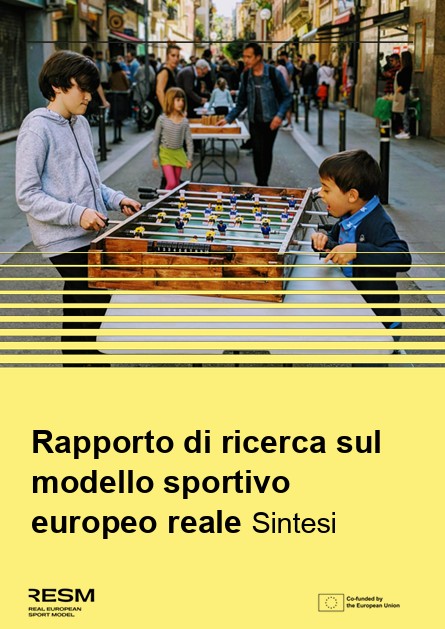
On this occasion, the research report produced as part of the Real European Sport Model (RESM) project will be presented; it examines the extent to which the European Sport Model (ESM) reflects the current organization and participation in European sports. The report analyses how key concepts such as solidarity, values, and autonomy have changed in meaning over the past 50 years, examines the reality of financial flows between grassroots and elite sports, and explores which funding mechanisms and resources are essential for participation.
Spectator-oriented elite sports are becoming increasingly popular. At the same time, Europe is witnessing a decline in physical activity at the grassroots level. While elite professional sports—particularly soccer—continue to generate enormous profits, policymakers and governing bodies continue to cite the ESM as their central guiding doctrine.
The existing model assumes that sport is organized according to a pyramid structure in which core values are promoted, governing bodies oversee the management of each discipline, and revenues from elite sport are redistributed to the grassroots. But if participation is declining, this model is not working as it should.
“The diverse financial landscape of direct and indirect contributions to sports activities in Europe remains largely unsupported by financial redistribution from sports governing bodies,” the research states. By way of example, it highlights that such payments accounted for only 0.2% (€13.75 million) of UEFA’s annual revenue in the 2023/24 season.
Based on research conducted by the Danish Institute for Sports Studies / Play the Game and the Université Côte d'Azur, the report argues that the dominant narrative focuses too much on elite competitions and does not reflect how most sports are organized or how most European citizens engage in physical activity.
Lack of implementation mechanisms
According to the report, the six main characteristics of the ESM are autonomy, free competition, the pyramid structure, solidarity, values, and the promotion of volunteering. However, most of these concepts and ideals have changed significantly over time. In particular, the concepts of autonomy, solidarity, volunteering, and the very definition of sport have drifted from their original meanings. Furthermore, most of these concepts lack implementation mechanisms, and their impact cannot be accurately measured.
European institutions have been discussing a common framework for sport since 1975, the report notes, and today policymakers are fully aware that the ESM is not functioning optimally. For example, in its 2007 White Paper on Sport, the European Commission acknowledged that, given the complexity and diversity of national structures, defining a single organizational model for sport in Europe was unrealistic.
“This new report challenges some of the long-standing myths in the sports sector,” says ISCA President Mogens Kirkeby. “It helps provide a more accurate picture for policymakers who want to understand participation in sport in Europe from the citizens’ perspective. Due to declining participation in sport, many citizens are not reaping the social, mental, and physical benefits of an active lifestyle. This leads us to ask whether the European sports model reflects reality or perpetuates an outdated narrative.”
What needs to change? The report proposes a new version of the ESM that focuses on a common denominator: sports activity. The definition of such activity should take into account independent activities that use only citizens’ resources and/or environments, as well as existing public and private resources, such as fitness apps.
To read the Executive Summary Research document click here
(article by Marcus Hoy, ISCA – with contributions from Daniela Conti, Uisp)
Project funded by the European Union. The opinions and views expressed are, however, solely those of the author(s) and do not necessarily reflect those of the European Union or the Education, Audiovisual and Culture Executive Agency (EACEA). Neither the European Union nor the EACEA can be held responsible for them.
NOTIZIE DA UISP NAZIONALE
CONTATTI
Ufficio progetti - Sede Uisp Nazionale
L.go Nino Franchellucci, 73 00155 Roma
Tel.: +39.06.43984350 - 345 - 346
Fax: 06.43984320
e-mail: progetti@uisp.it
Facebook
Twitter