
Progetti
Grassroots Sports: Who decides who can participate?
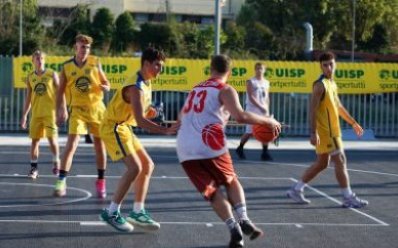
When we talk about discrimination in sports, we tend to focus on access: who can participate, who can afford it, and who faces visible barriers. But beneath these important questions lies something deeper and far more uncomfortable: who holds the power in sports, and who has the right to define what equality truly means?
Grassroots sports often present themselves as inherently inclusive: community-based, volunteer-led, and open to everyone. However, power does not simply disappear because an organization is local. It changes form. It takes root in traditions, informal hierarchies, and the silent weight of “the way things have always been done.”
“Even the language we use can conceal deep-rooted power dynamics; the word inclusion itself is an example: who is doing the including, and who is being included?” Stefania N'Kombo Josè Teresa, Lunaria
A recent reflection within the ChangeMakers project, during an online session dedicated to analyzing power dynamics in sports, prompted a deeper examination of these underlying structures. Thanks to the experience of Lunaria, it became clear that discrimination in grassroots sports rarely concerns only individual biases. Rather, it concerns representation, decision-making, and who truly has a say.
Power is not just a position
Power in sports is often associated with formal titles: presidents, board members, and head coaches. But power also operates in more subtle ways: in meetings, in WhatsApp groups, in selection discussions, in who feels confident enough to speak up and who does not.
It operates on multiple levels: When we reduce discrimination to attitudes or behaviors, we overlook these structural levels. A club may insist that “there are no real barriers,” yet still fail to take meaningful steps toward diversity. The absence of visible exclusion does not mean the presence of equality. It often simply means that existing power structures remain unchallenged, and when leadership roles consistently reflect a narrow demographic (often white, male, and middle-class), a powerful message is sent about who the sport truly belongs to.
- Among individuals (who is interrupted and who is listened to);
- Within organizations (who sets priorities and controls resources);
- In society (how social class, gender, ethnicity, education, and economic background influence access to leadership);
- Even among countries (whose sports model is considered the benchmark).
This is an issue that should be taken seriously, and as one of our ChangeMakers stated (discover our ChangeMakers here):
“Our organizational structures lack representation of marginalized groups, especially in leadership positions. For example, although our organization is predominantly composed of women, many of the leadership positions are held by men. This means that a very specific social group leads our organization and decides which issues should receive attention, who is promoted to positions with decision-making power, etc.”
Representation Beyond the Numbers
Representation can often be measured numerically: how many women are on the board of directors, or how many coaches have a migrant background?
But representation operates on at least three interconnected levels:
Elite sport has demonstrated, in some contexts, that change is possible. The growing diversity of some national teams has challenged outdated stereotypes about who “looks like” an athlete. These changes are important. Images shape the imagination. The imagination shapes a sense of belonging.
- Visibility and access: who is present?
- Public image: how are athletes and leaders portrayed?
- Influence: who influences decisions?
However, at the grassroots level, representation in leadership often lags behind participation. Even organizations with a majority of female members may find that key decision-making roles remain disproportionately male. This highlights a crucial point: diversity in participation does not automatically translate to equality in power.
If the same social group consistently determines which issues are prioritized, which initiatives receive funding, and which voices are amplified, inclusion remains partial, even if participation statistics seem encouraging.
The Silence in the Room
Power isn’t just about who speaks the loudest. It’s also about who remains silent.
In many organizations, ideas are judged differently depending on who expresses them. Seniority, confidence, accent, age, and social background subtly influence which contributions are taken seriously. True inclusion requires more than just inviting diverse people into the room. It requires asking difficult questions: One insight that emerged from discussions within the ChangeMakers community was particularly significant: inclusion requires that, in discussions, ideas carry more weight than the position of the person expressing them. It’s easy to say, but very difficult to put into practice.
- Which ideas influence the final decision?
- Who feels confident challenging the status quo?
- Who is completely absent, and why?
Creating space for diverse voices requires conscious facilitation, active listening, and transparency about how decisions are made. Without these elements, representation risks becoming symbolic rather than transformative.
Unequal Voices in the System
Power imbalances also exist across different levels of governance. Larger, more established organizations often exert greater influence over funding flows, strategic direction, and the public narrative. Smaller clubs, volunteers, and marginalized groups may struggle to make their voices heard.
Grassroots sport does not exist in isolation. It is embedded in broader political, economic, and cultural systems that determine who has access to resources and authority. For inclusion to be meaningful, it must involve a redistribution of influence, not simply a diversification of participation.
One of the ChangeMakers proposed some simple steps anyone can take to ensure that all voices are heard:
“We can ensure that ideas matter in discussions rather than the position of the person expressing them. By paying attention not only to who is speaking and taking up space in a room, but also to who isn’t, and then asking ourselves why. By asking ourselves how our position and status might influence other people and their ability to voice concerns, ideas, and so on. By ensuring that people from marginalized groups are not only heard but also actively invited to participate.”
A journey, not a to-do list
Power shift is not a quick fix. It’s not about checking boxes or drafting another policy. It requires ongoing reflection, courage, and a willingness to challenge entrenched habits—especially on the part of those who currently benefit from them.
As Carole Ponchon, lead of the ChangeMakers project, stated:
“If we are serious about addressing discrimination in grassroots sport, we must go beyond symbolic inclusion. We must ask difficult questions about who holds influence in our organizations and whose voices are systematically absent.
‘ChangeMaking’ is not simply about opening doors. It is about examining who holds the keys and who decides where those doors lead.
True transformation begins when leaders are ready to share power, listen differently, and create structures where diverse voices not only participate but influence decisions. We invite clubs, federations, and volunteers across Europe to embark on this journey with us. Because inclusive sport will not happen by chance: it must be built, intentionally and collectively.”
The challenge is now clear. If grassroots sport truly wants to be a space where everyone can feel at ease, it must look beyond participation figures and confront the power dynamics embedded in its daily practices.
Until power changes, inequality will simply continue to adapt. (article by Carole Ponchon – ISCA)
Funded by the European Union. Views and opinions expressed are however those of the author(s) only and do not necessarily reflect those of the European Union or the European Education and Culture Executive Agency (EACEA). Neither the European Union nor EACEA can be held responsible for them.
NOTIZIE DA UISP NAZIONALE

CONTATTI
Ufficio progetti - Sede Uisp Nazionale
L.go Nino Franchellucci, 73 00155 Roma
Tel.: +39.06.43984350 - 345 - 346
Fax: 06.43984320
e-mail: progetti@uisp.it
Facebook
Twitter